Auto-scrubber, buffer, burnisher: which one your floor needs
They are not interchangeable, and using the wrong one is how a good floor gets tired early.
September 1, 2026 · 3 min read
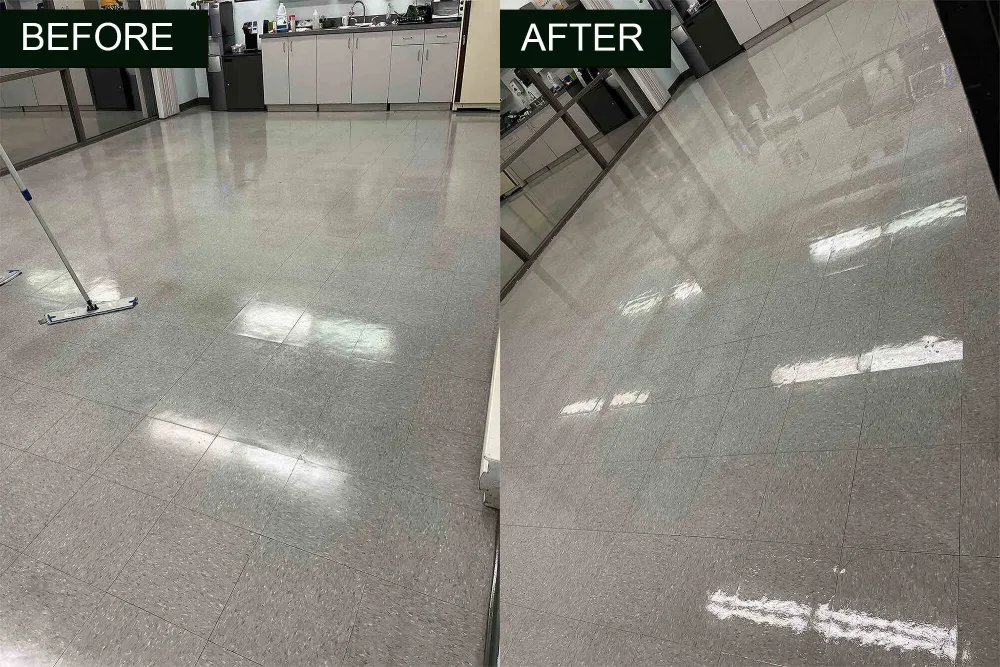
Walk into any commercial cleaning supplier and you will see three machines that look broadly alike. All of them are round, all of them spin, and all of them are wheeled around a floor by someone in a hi-vis vest. They do not do the same job, and a company that owns one and uses it for everything will eventually cost you a floor.
The auto-scrubber washes and dries in one pass
An auto-scrubber lays down solution, scrubs it, and vacuums it back up behind itself in a single pass. That last part is the whole point. A mop leaves water on a floor and somebody has to wait for it to dry, which in a shopping centre or a school corridor means a slip hazard sitting in the busiest part of the building.
Because it dries fast, the auto-scrubber is what you want anywhere the floor cannot be closed off. Shopping centres, schools and hospitals are the classic cases. They come in compact walk-behind models for tight areas and ride-on models for large open floors, and the pads change depending on whether you are on tile, sealed concrete or linoleum.
The buffer restores a surface that is already finished
A buffer runs slower and is about appearance rather than removal. It works scuffs, ground-in dirt and light scratches back out of a floor that already has a finish on it, and it brings the shine back up. This is the machine for waxed floors and for high-traffic areas where the surface has gone flat and grey rather than dirty.
Pads matter here too. Hardwood, vinyl and marble all want different aggression, and running the wrong pad on a soft finish takes off more than you wanted.
The burnisher is the one that produces the wet look
A burnisher runs much faster than a buffer. The speed generates enough heat to slightly melt and level the top wax layer, which is what produces the glossy wet look you see in a hotel lobby or a well-kept school hallway. It is not cleaning in the ordinary sense. It is refinishing what is already there.
That is also why it is the last step rather than the first. Burnishing a dirty floor just seals the dirt in under a shine.
How to tell which one you need
- Floor looks dirty and traffic never stops: auto-scrubber, because drying time is your real constraint
- Floor is clean but flat and scuffed: buffer, to work the marks out of the existing finish
- Floor is clean and you want it to look like the day it went in: burnisher, as a finishing pass
- Floor has yellowed, built up layers, or shows edge build near the walls: it needs stripping back and refinishing before any of the three will help
Full floor care runs the whole sequence: auto-scrubbing, polishing, stripping, waxing and burnishing, applied in the order the floor actually needs rather than the order that is quickest.
Drying time is a safety decision
It is worth being blunt about why the auto-scrubber keeps coming up. Wet floors are the most common preventable hazard in a commercial building, and they are most dangerous in exactly the places that get cleaned most often: entrances, corridors and washrooms.
A machine that removes its own water is not a luxury in a building that cannot close. It is the difference between cleaning during business hours being possible and cleaning during business hours being a liability. If your building genuinely never empties, this is the single most important question to ask about a cleaner's equipment.
Why the measurement matters more than the machine
Floor work is priced on area, so a quote built on a guessed square footage is a quote that will be renegotiated later. Swept Space measures sites precisely and prices against the real number. It is a dull detail that saves an awkward conversation three months in.
For strata buildings, floor maintenance is usually worth bundling with the regular common area work. Entranceways, lobbies and hallways are the floors owners and prospective buyers actually look at, and they are the ones that age fastest because everybody crosses them. Doing them on a schedule is considerably cheaper than stripping and refinishing a neglected lobby after three years.
If you are not sure which category your floor falls into, that is a reasonable thing to ask about during a walkthrough. Bring the machine question up directly. The answer tells you quite a lot about who you are dealing with.
Swept Space Cleaning, 250.412.3522
Call 250.412.3522More articles
What actually happens on a commercial cleaning walkthrough
A commercial quote given over the phone is a guess. Here is what the visit is for.
Handing a cleaner your keys: what to check first
The whole model depends on trust, so the checks behind it should be easy to see.